Thursday, January 19, 2017

Night Cafe at Arles

Taken from: Abc Gallery
     Night Cafe at Arles is a realistic painting that Paul Gauguin had painted while in Arles. This painting is located in Pushkin Museum, which is in Moscow, Russia. The painting is related to the book Sunflowers, because Gauguin came to stay with Van Gogh after receiving an invitation from Theo. The invitation consisted of Gauguin to help make Van Gogh's paintings sell. Both Van Gogh and Gauguin painted similar pictures, however, their styles of painting were different. This painting shows that Gauguin took the time to paint minor details. For example, the facial features of the people in the painting.  This is important because it contrasts Gauguin's paintings from Van Gogh. 
     Night Cafe at Arles was painted in 1888. The medium of the painting is oil on canvas. The style and technique that is used is this painting is a warm color palette. Gauguin also used the technique of long brushstrokes. Gauguin also created two different scenes within one scene. The first scene is the drinkers in the background, and the other scene is Madame Ginoux in the foreground of the painting. The main subject of this painting is loneliness. It conveys loneliness because the women of the painting is separating herself from the other people. 
     

3 Aspects of Society in Arles


   During our time reading the novel Sunflowers by Sheramy Bundrick, we wondered about the societal standards of beauty during the time this book took place. Rachel was a prostitute in the book, and the way that all men flocked to her in the brothel makes us question how society viewed women and what their standards of beauty were. According to Medical Daily, women embraced their curves. Voluptuous women were seen as beauty in Europe in the 1800s. Compared to the 21st century where women are expected to be skinny to be pretty, women in the 1800s were more in the plump side.
   Another aspect of society that we are curious about is the fashion. In the book, the fashion of the characters was described in detail. For example, when Doctor Felix Rey brought Rachel to visit Vincent Van Gogh in Paris, she had to dress up in order to be seen as a regular person on the train to the hospital. Fashion in the 1800s was far more exquisite and fancy than the fashion of modern times, and the fancier you dressed meant the wealthier you were. Women would typically wear dresses or skirts. Men would typically wear trousers, fitted jackets, and hats like the straw hat that Van Gogh would always wear.
  The last aspect of society that we are curious about are the houses that are there. Van Gogh's Yellow House was mentioned a lot in the novel, and this makes us wonder how other houses there are like. The small town of Arles that is portrayed in the book Sunflowers shows very little transportation and the main form of transportation is by foot. The route from the brothel to Vincent's yellow house seems so short that it gives us an idea of how small the town of Arles is. There must be very little houses in Arles, since everyone seems to know of each other.
  These 3 aspects from the book stood out the most to us, and we enjoyed researching these societal aspects of the 1880s in Europe.

Portrait of Joseph Roulin

Image result for joseph roulin
Taken from: Museum of Fine Arts
  The painting "Postman Joseph Roulin" is one out of seven paintings Van Gogh had painted of him. Van Gogh had painted 25 portraits of the Roulin family. This work of art by Vincent was realistic since Roulin had been his model and for the 7 others as well. This painting showed that when Van Gogh had arrived in Arles he had focused solely on the man and woman living there. Van Gogh had been struggling with his hallucinations around the time he painted this yet the colors he used on Roulin was bright which was surprising since he often had his hallucinations.
  The medium Van Gogh had used for this painting was oil on canvas, The subject is to show a postman working a job but yet looks so full of energy stopped in time on a canvas. The techniques he used was the overlaying of paint over his canvas to show the short strokes when he had painted this. He had used these colors to show what Roulin wears for the job but to also show how energetic he was about his job. It shows his loyalty to his friend since everyone in Arles had started calling him crazy but the Roulin family. 

Book Review


  The book Sunflowers by Sheramy Bundrick is a book that reaches into our emotions while reading about the sad love between Vincent Van Gogh and Rachel. Their fated meeting was on a hot sunny day where Van Gogh had sketched Rachel asleep under a tree. Rachel was angry at Van Gogh but gradually she got closer to him and that eventually turned into something other than warming Van Gogh's bed. There was no problem in the relationship between Van Gogh and Rachel, but Van Gogh and his friend Gauguin. This friendship took a toll on Van Gogh's mental state of mind. Gauguin had not liked Arles and constantly made himself seem superior to Van Gogh. During the night Gauguin was going to leave Arles, he had tried to get Rachel to sleep with her. That made Van Gogh snap with the amount of stress he had before causing a fight. This leads to a loss that Rachel knew might have helped Vincent and herself. The constant hallucinations made Van Gogh realize that he can not be alone but does not want to depend on Rachel like he does to his younger brother Theo. It leads him to the decision of going into an asylum. The constant letters and love poured into the letters back and forth tugs on heart strings in empathy for their love. But soon, tragic news reaches the ears of Rachel and she was finally able to leave the brothel. Even though she was able to leave, the one love she had given her love to had died. Van Gogh had shot himself with a handgun all alone in the middle of a field.
  This book is enticing with the vivid details of the hallucinations and the love between Van Gogh and Rachel. The book had discreetly given the image of sex by subtly writing they were in a room together but not describing the details. Sunflowers showed us the difficulties of an unsuccessful painter and how life can be unsuccessful but cheerful things can still be found in life. When Ms.Kaczmarek had given us a description of the book Sunflowers, the book had caught the attention of many, and we were one of many.


The Brothel

                                                    The Brothel by Vincent Van Gogh

  Vincent painted The Brothel to depict the life of Arles during the night. He associated himself with the working class and made their lifestyles the main theme of his paintings. The Brothel was a place of work for prostitutes. There they waited for their customers so that they could take them back home. This is an important painting in the book because Rachel, Vincent's girlfriend, was one of these prostitutes. Since he enjoyed painting people and their lifestyle he took the advantage of Rachel's job and decided to paint her and the others. Rachel did not think this was a good idea, she felt that she was only seen as a prostitute and not for who she is. After a while she agreed to the painting. 
   The painting was created on a oil canvas with oil paints in 1888. His uses his famous color yellow to paint Rachel in the yellow dress that he loves. He also adds in other colors of red, green and black. He uses short brushstrokes that are rough.

Courtyard of the Hospital at Arles


  Courtyard of the Hospital at Arles is a realistic painting done by Vincent van Gogh in April of 1889. This painting is now located in Oskar Reinhart Museum in Switzerland. This painting was most likely painted while Van Gogh was in the hospital getting treatment from his crises. This painting was briefly mentioned in the book Sunflowers by Sheramy Bundrick. Van Gogh would often complain that he had nothing to do in the hospital during his stay, and when he did have his sketch books and pencils, he would yearn to paint. The inspiration for this painting was probably him looking out the window from his hospital room or from his walks around the courtyard. 
  This painting was painted on canvas with oil paints. The light brushstrokes of the shrubbery and plants show their texture. He uses a bright palette which includes bright yellows, reds, blues, and greens. The painting also shows a contrast between the dark greens on the left side and the bright yellows on the right side. His attention for detail is shown by him painting individual grass pieces with his light brushstrokes. The bare trees and dark surroundings may symbolize the current state he was in, and the bright colors on the other side represent the light at the end of the tunnel, or his crises.

The Painter of Sunflowers


                                                      Painter of Sunflower-Paul Gauguin


  The Painter of Sunflowers  was painted in 1888 by Paul Gauguin. It is of Vincent Van Gogh, the artist of Sunflowers. Van Gogh created many different versions of Sunflowers to decorate around the house he moved into and Gauguin joined him after for a sort period of time. This is important to the text because you can see how Vincent paints and how his surroundings influence his paintings. This is also important because you can tell the relationship between Gauguin and Van Gogh. Although the two of them encountered many conflicts, they could not stay away from each other. They enjoyed the company of one another. 
  There is no traditional subject in this painting. There is nothing in the medium but Vincent's arm and it is clear that that isn't the purpose of the painting. The subjects of the painting are all pushed to the corner of the painting. You can see Vincent from the waist up and it shows the way he paints. He has the brush in his right hand and the canvas in his left hand. This painting has a style of Post-Impressionism. Gauguin uses short but rough brushstrokes. His use of colors on the oil canvas is bright to show how colorful Van Gogh's Sunflowers are.

Wednesday, January 18, 2017

Still Life: Drawing Board, Pipe, Onions, and Sealing Wax


   Still Life: Drawing Board, Pipe, Onions, and Sealing Wax is a realistic painting done by Vincent van Gogh which is now located in Kroller Muller Museum in the Netherlands. This painting was painted in 1888, after Van Gogh was discharged from the hospital after one of his many crises. Right when he arrived home from the hospital, he quickly returned to his studio and began painting again. He began with still life to practice his rusty painting skills after being enclosed in a hospital for 2 weeks. In the book Sunflowers by Sheramy Bundrick, it is mentioned that Van Gogh has agreed to do a portrait of his doctor, Dr. Felix Rey soon after his release of the hospital, and he worries that he would only be able to paint still life after his sickness.
  Van Gogh uses oil on canvas for this painting. He paints the many things on his cluttered table to practice his abilities after a short period of not painting. The items seen in this painting are onions on a plate, a book,  an empty bottle of wine, an envelope, a pipe, a green kettle, and a candlestick. He used light strokes to make up the shading and shadows of the objects. He uses a vibrant palette in this painting, such as a bright green for the kettle and his signature yellow on the tabletop. The angle of this painting seems as if he is standing over the table off to the side to capture all the objects on top of the table. His skill is shown in the attention to detail in the painting considering his short break from painting in the hospital.

Thursday, January 12, 2017

Self-Portrait with Bandaged Ear

Taken from: Courtauld Gallery

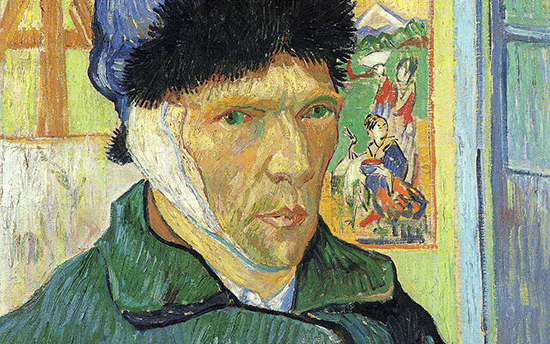
     Self-Portrait with Bandaged Ear is a realistic painting that is now located in The Courtauld Gallery which is in London. This painting was mentioned in the book Sunflowers in which Van Gogh painted himself a few weeks after with a bandage over his ear. This bandage was on his ear because he had cut a part of his ear off to show his love to Rachel. The purpose of him doing a self portrait is to show how important this event is to him. It was also because he thought it will help him get over his mental issues. The painting is like a mirroring image to him. Van Gogh is seem to be in his room with a coat and a hat.
     The painting in the back seems to bring Japanese culture into the painting. The action of Van Gogh cutting off his lobe can be linked to what is done in Japanese culture. In Japanese culture this is known as Shinju. This is basically cutting off a piece of your body part to show the love you have for someone else. This painting was created in 1889. The medium is Oil on Canvas. The main subject of this painting is Van Gogh after cutting off his own earlobe. The style and technique that is being used in long brush strokes. The long brush strokes can be seen in the hat area. The next technique Van Gogh used was expressionism. This is when a painting uses vivid colors to show emotions.  

Portrait of Dr. Felix


Portrait of Dr. Felix Rey, 1889 - Vincent van Gogh
Taken from: Vggallery

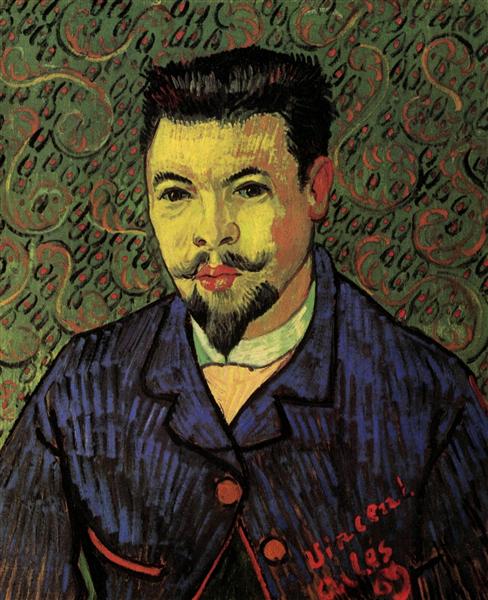
   The Portrait of Dr. Felix Rey that was painted by Vincent Van Gogh in January 1889. The painting is a realistic because it is a painting of a real person that had an impact in his life. The portrait was given as a gift to the doctor. This portrait was painted after Van Gogh was discharged from the hospital. It is included in the book Sunflowers because Van Gogh painted Dr. Felix Rey to show that he appreciates him. Van Gogh wants to show his appreciation because Dr. Rey took care of him when he wasn't stabled enough to take care of himself. Dr. Felix Rey was the only person to show that he really cared for Van Gogh. According to Van Gogh Studio, Dr. Rey was known as one of the most sympathetic doctors that Van Gogh had. This painting is important to the book because it is allows the to know about the appreciation Van Gogh has for him.
      This painting can be found in the Pushkin Museum. The medium of this painting is oil on canvas, just like his other works. The main subject of this painting is Dr. Felix Rey. The style and technique that was used was quick brush strokes. The colors used in the painting is dark. However, the face of Dr. Rey seems to have light  reflecting on to his face to show the importance of him. The way the eyes were painted, Van Gogh wanted to attempt to showing the feelings the doctor had towards him.  
     

Sunflowers

The painting Vase with Twelve Sunflowers is one of four paintings of sunflowers Van Gogh painted in 1887-1888. This particular painting was meant to be put in Gauguin's room which he could look at as a gift for his arrival in Arles. This painting is realistic because Van Gogh had sunflowers that he used to paint this painting. This painting shows that Van Gogh was working hard on the sunflowers because he was adamant on completing his "Sunflower" series to show his friend Paul Gauguin. It is important because it shows that he had wanted to decorate his room to make sure that the sunflowers painted will give him strength when looking at the blue walls. He also most likely made the series to give him inspiration no matter where he was in the house.
  The medium Van Gogh used to the sunflowers was oil on canvas. The subject is to show the scenery portraying the sunflowers in a vase with a blue background. The technique and styles used were heavy brush strokes and paint that was applied thickly. The techniques and styles he used was to use the colors to express himself so others can understand his work too.


Madame Roulin and Her Baby


   Madame Roulin and Her Baby is a real painting that is now located in The Metropolitan Museum of Art. This painting is mentioned in the book Sunflowers by Sheramy Bundrick as well. The Roulin family has gotten many of their portraits painted by Vincent Van Gogh, a close family friend. The baby in this painting is Marcelle, the youngest of the Roulin family.
   This painting's significance in the book is shown through Rachel, Van Gogh's lover. Rachel was once pregnant with Van Gogh's child, but because of the trauma around her, such as Van Gogh cutting off his ear for her, she experienced a miscarriage. Whenever she sees this painting in Van Gogh's house, she becomes very emotional because of the thoughts of what might have been. Rachel wishes to become Van Gogh's wife and start a family with him, but because of her miscarriage and Van Gogh's constant sickness, it is very hard for her to accept her loss.
   This painting was painted in 1888 with oil on canvas. The main subject of the painting is Marcelle Roulin, who is being held up by her mother, Madame Roulin. The bright yellow background blends into Madame Roulin's face, which emphasizes the focus on the baby's face. The yellow glow in the background can also symbolize a halo, which shows Van Gogh's perspective of the family. Van Gogh uses colors like yellow and green which are very close on the color wheel to symbolize the mother and the baby's closeness. The streaks in the mother's hair shows its texture. His thick brushstrokes hint that baby Marcelle has posed for Van Gogh.

Night Cafe in the Place Lamartine


   The Night Cafe in the Place Lamartine is a real painting done by Vincent Van Gogh. This painting is mentioned in the book, Sunflowers by Sheramy Bundrick. Van Gogh would often visit this cafe, owned by his good friends, Madame and Monsieur Ginoux. Van Gogh lived in the top floor of this cafe, and later gave this painting to the Ginoux's as his rent.
  The gloomy ambience shown through this painting portrays Van Gogh's perspective of the solemn and serious customers of the cafe. Van Gogh describes this cafe as a place where people can "ruin themselves," which explains the tired and melancholy customers.
  This painting was finished in September of 1888. Van Gogh used oil on canvas to complete this painting. The painting focuses on the large pool table in the middle of the cafe, as the dim lights shine upon them to create a slight shadow underneath. The tired customers are seen on the sides without any faces. Van Gogh uses light strokes to paint the rays of light that are shone through the lamps on the ceiling. The radiating light emphasizes how it contributes to the environment of the cafe in significant ways.
  This painting is now located in the Yale University Art Gallery.

Wednesday, January 11, 2017

Yellow House


                                                Yellow House by Vincent Van Gogh 
             
                           
  The Yellow House painting is located in  Van Goghs Museum located in Amsterdam, Holland. This is the house that Van Gogh lived in with Gauguin for a short period of time. This was what he called a dream "Studio of the South," after he didn't like living in the rooms above the Cafe de la Gare. He didn't think the two rooms in the restaurant was enough and he felt like he was being over-charged for something like that so he took them to court and won the case. He decided to use the money to rent a house and began looking for a house after the case was settled.
  In May 1888, he rented the yellow house and wrote a letter telling  his brother, Theo, about it. He described the house as yellow on the outside and the walls inside of the house as white with a lime-washed color. It has four rooms and he got it for 15 Francs a month. He furnished the rooms and had two of the rooms as closets for his paintings. One of the rooms was decorated for when Gauguin would arrive. He also chose paintings to show Gauguin and he decided to show him his painting of Sunflowers. This was seen in the book Sunflowers.
  The Yellow House was painted on a canvas with oil. It took a few steps in order for him to complete this painting. He started off with a blueprint in pencil of the painting. He used brown and black as foundation of the painting to fill in major details. He used a yellow, blue and green palette to give the painting depth. He used quick brush strokes and the technique of stippling which was popular around the time of Neoimpressionists.

Mission Statement For "Sunflowers"

This blog is created for school purposes to learn more about the paintings of Van Gogh and other artists mentioned in the book "Sunflowers" by Sheramy Bundrick. Enjoy the blog and we hope you will learn lots from it.